


| Description | Section | |
Standard Disclosures Part I: Profile Disclosures |
||
1. Strategy and Analysis |
||
| 1.1 | Statement from the most senior decision-maker of the organization | Chairman’s Message |
2. Organizational Profile |
||
| 2.1 | Name of the organization | Organizational Profile |
| 2.2 | Primary brands, products, and/or services | Organizational Profile |
| 2.3 | Operational structure of the organization, including main divisions, operating companies, subsidiaries, and joint ventures | Organizational Profile |
| 2.4 | Location of organization's headquarters | Organizational Profile |
| 2.5 | Number of countries where the organization operates, and names of countries with either major operations or that are specifically relevant to the sustainability issues covered in the report | Organizational Profile |
| 2.6 | Nature of ownership and legal form | Organizational Profile |
| 2.7 | Markets served (including geographic breakdown, sectors served, and types of customers/beneficiaries) | Organizational Profile |
| 2.8 | Scale of the reporting organization | Organizational Profile |
| 2.9 | Significant changes during the reporting period regarding size, structure, or ownership | Organizational Profile |
| 2.10 | Awards received in the reporting period | Recognition |
3. Report Parameters |
||
| 3.1 | Reporting period (e.g., fiscal/calendar year) for information provided | Report Structure |
| 3.2 | Date of most recent previous report (if any) | Report Structure |
| 3.3 | Reporting cycle (annual, biennial, etc.) | Report Boundary |
| 3.4 | Contact point for questions regarding the report or its contents | Contact |
| 3.5 | Process for defining report content | Report Boundary |
| 3.6 | Boundary of the report (e.g., countries, divisions, subsidiaries, leased facilities, joint ventures, suppliers). | Report Boundary |
| 3.7 | State any specific limitations on the scope or boundary of the report | Report Boundary |
| 3.8 | Basis for reporting on joint ventures, subsidiaries, leased facilities, outsourced operations, and other entities that can significantly affect comparability from period to period and/or between organizations | Report Boundary |
| 3.10 | Explanation of the effect of any re-statements of information provided in earlier reports, and the reasons for such re-statement (e.g.,mergers/acquisitions, change of base years/periods, nature of business, measurement methods). | Report Structure |
| 3.11 | Significant changes from previous reporting periods in the scope, boundary, or measurement methods applied in the report. | Report Structure |
| 3.12 | Table identifying the location of the Standard Disclosures in the report. | GRI Content Index |
4. Governance, Commitments, and Engagement |
||
| 4.1 | Governance structure of the organization, including committees under the highest governance body responsible for specific tasks, such as setting strategy or organizational oversight. | Corporate Governance |
| 4.2 | Indicate whether the Chair of the highest governance body is also an executive officer. | Corporate Governance |
| 4.3 | For organizations that have a unitary board structure, state the number and gender of members of the highest governance body that are independent and/or non-executive members. | Corporate Governance |
| 4.4 | Mechanisms for shareholders and employees to provide recommendations or direction to the highest governance body. | Corporate Governance and Institutional Capital |
| 4.13 | Memberships in associations (such as industry associations) and/or national/international advocacy organizations in which the organization | Organizational Knowledge |
| 4.14 | List of stakeholder groups engaged by the organization. | Stakeholder Engagement |
| 4.15 | Basis for identification and selection of stakeholders with whom to engage. | Stakeholder Engagement |
Standard Disclosures Part iii: Performance Indicators |
||
Economic |
||
Economic Performance |
||
| EC1 | Direct economic value generated and distributed, including revenues, operating costs, employee compensation, donations and other community investments, retained earnings, and payments to capital providers and governments. | Statement of Economic Value Added and Distributed |
Market Presence |
||
| EC7 | Procedures for local hiring and proportion of senior management hired from the local community at significant locations of operation. | Employee Recruitment Analysis |
Environmental |
||
Energy |
||
| EN3 | Direct energy consumption by primary energy source | Energy |
| EN4 | Indirect energy consumption by primary source | Energy |
| EN5 | Energy saved due to conservation and efficiency improvements. | Energy |
| EN6 | Initiatives to provide energy-efficient or renewable energy based products and services, and reductions in energy requirements as a result of these initiatives | Energy |
| EN7 | Initiatives to reduce indirect energy consumption and reductions achieved | Energy |
Water |
||
| EN8 | Total water withdrawal by source | Water |
| EN10 | Percentage and total volume of water recycled and reused | Water |
Biodiversity |
||
| EN14 | Strategies, current actions, and future plans for managing impacts on biodiversity | Biodiversity |
Emissions, Effluents and Waste |
||
| EN16 | Total direct and indirect greenhouse gas emissions by weight | Emissions |
| EN18 | Initiatives to reduce greenhouse gas emissions and reductions achieved | Emissions |
| EN19 | Emissions of ozone-depleting substances by weight | Emissions |
| EN21 | Total water discharge by quality and destination | Water |
| EN22 | Total weight of waste by type and disposal method | Waste |
| EN23 | Total number and volume of significant spills | Emissions |
Social: Labor Practices and Decent Work |
||
Employment |
||
| LA1 | Total workforce by employment type, employment contract, and region, broken down by gender. | Employee Population Analysis |
| LA2 | Total number and rate of new employee hires and employee turnover by age group, gender, and region. | Employee Recruitment Analysis and Employee Turnover Analysis |
| LA3 | Benefits provided to full-time employees that are not provided to temporary or part-time employees, by major operations. | Employee Benefits |
| LA15 | Return to work and retention rates after parental leave, by gender. | Employee Benefits |
Occupational Health and Safety |
||
Training and Education |
||
| LA10 | Average hours of training per year per employee by gender, and by employee category. | Training and Development |
| LA11 | Programs for skills management and lifelong learning that support the continued employability of employees and assist them in managing career endings. | Training and Development |
| LA12 | Percentage of employees receiving regular performance and career development reviews, by gender. | Training and Development |
Diversity and Equal Opportunity |
||
| LA13 | Composition of governance bodies and breakdown of employees per employee category according to gender, age group, minority group membership, and other indicators of diversity. | Jetwing Lighthouse - the Employer |
Equal Remuneration for Women and Men |
||
| LA14 | Ratio of basic salary and remuneration of women to men by employee category, by significant locations of operation. | Jetwing Lighthouse - the Employer |
Social: Society |
||
Local Communities |
||
| SO1 | Percentage of operations with implemented local community engagement, impact assessments, and development programs. | Social Capital |
Social: Product Responsibility |
||
Product and service labelling |
||
| PR5 | Practices related to customer satisfaction, including results of surveys measuring customer satisfaction. | Guest Satisfaction |
Marketing communications |
||
| PR6 | Programs for adherence to laws, standards, and voluntary codes related to marketing communications, including advertising, promotion, and sponsorship. | Advertising and Marketing |
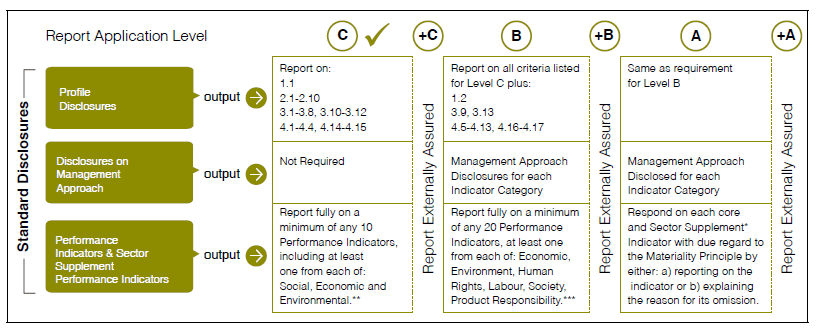
* Sector supplement in final version
** performance Indicators may be selected from any finalised Sector Supplement, but 7 of the 10 must be from the original GRI Guidelines
*** Performance Indicators may be selected from any finalised Sector Supplement, but 14 of the 20 must be from the original GRI Guidelines