


The Global Economy
Global output grew by 3%, marginally lower compared to the 3.1% growth recorded in 2012. Economic activity strengthened during the second half of 2013 and as a result, the underlying momentum appeared to be strong. According to the IMF, activity is expected to improve further in 2014/15, largely on account of recovery in the advanced economies. Global growth is now projected at 3.7% in 2014 and at 3.9% in 2015.
Advanced economies registered a growth of 1.3% in 2013, marginally lower than the growth of 1.4% recorded in 2012. The US grew by 1.9% in 2013 compared to 2.8% 2012. Meanwhile, the Euro area ended the prolonged recession narrowing the negative growth to 0.4%, from 0.7% in 2012.
Global Tourism
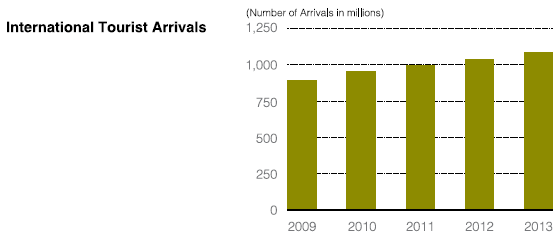
During the year, international tourist arrivals grew by 5% and reached a record 1,087 million, according to the latest UNWTO (United Nations World Tourism Organization) World Tourism Barometer. Despite global economic woes, international tourism results were well above expectations. An additional 52 million international tourists travelled the world in 2013. For 2014, UNWTO forecasts 4% to 4.5% growth - again, above the long term projections.
 |
Demand for international tourism was strongest for destinations in Asia and the Pacific (+6%), Africa (+6%) and Europe (+5%). The leading sub-regions were South East Asia (+10%), Central and Eastern Europe (+7%), Southern and Mediterranean Europe (+6%) and North Africa (+6%).
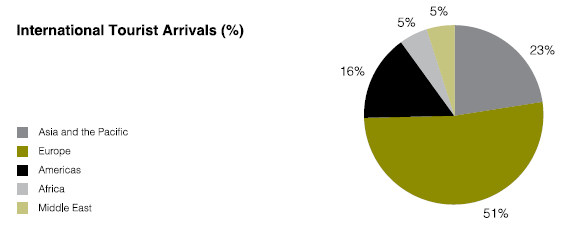 |
In relative terms, growth was strongest in Asia and the Pacific (+6%), where the number of international tourists grew by 14 million to reach 248 million. South East Asia (+10%) was the best performing sub-region, while growth was comparatively more moderate in South Asia (+5%), Oceania and North East Asia (+4% each).
Total export earnings generated by international tourism in 2013 reached US$ 1.4 trillion. Receipts earned by destinations from international visitors grew by 5% to reach US$ 1,159 billion, while an additional US$ 218 billion was earned by international passenger transport according to the UNWTO World Tourism Barometer.
The Sri Lankan Economy
Commendable Growth
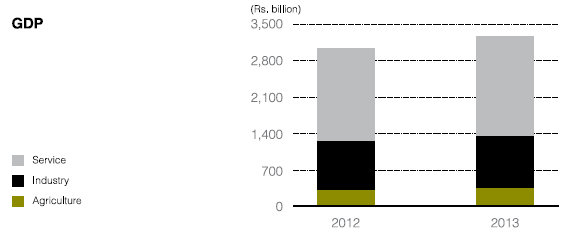
The Sri Lankan economy performed commendably, achieving an annual real GDP growth of 7.3% in 2013, in comparison to 6.3% achieved in 2012.
All sectors of the economy - Agriculture, Industry and Services - contributed positively to this growth.
 |
Favourable weather conditions and the gradual recovery in external demand supported the steady increase in economic growth.
Inflation
Inflation as measured by the Colombo Consumers’ Price Index (CCPI) (2006/07=100) which remained at single digit levels for the fifth consecutive year, gradually declined further to reach mid-single digits by the end of the year.
In this respect, prudent monetary management, improved domestic food supply and moderation of international commodity prices resulted in a gradual decline in inflation to 5.7% as at 31st March, 2014 on an annual average compared to 8.8% at 31st March, 2013.
Exchange Rates
Sri Lanka’s exchange rate policy in 2013 focused on maintaining flexibility in the determination of the exchange rates.
With the improvement in the external current account balance and significant in flows to the financial account, the BOP recorded an overall surplus of US$ 985 million in 2013 compared to a surplus of US$ 151 million in 2012.
Reflecting the improved BOP position, the reserve asset position of the country improved.
Overall, the rupee depreciated against the US$ by 3% to Rs. 130.72 by 31st March, 2014.
The reduction in policy interest rates and the excess liquidity in the money market facilitated the downward adjustment in market interest rates during the year.
The policy interest rates of the Central Bank were reduced by 100 basis points in two steps during 2013. (50 basis points in May and another 50 basis points in October 2013) The Central Bank reduced its Statutory Reserve Ratio (SRR) by 2 percentage points, with effect from July 2013.
The monthly average weighted prime lending rate (AWPR) declined by 477 basis points in 2013.
National Infrastructure Development
The year 2013 saw the completion and continuation of many key infrastructure projects including the country’s second international airport at Mattala, harbour and port development projects, Katunayake - Colombo expressway and highway development projects and the Northern railway project, power projects, as well as several rural infrastructure development projects.
The Colombo city beautification and countrywide township development projects aided the wellbeing of the population amongst several other benefits associated with such improvements, such as promoting Sri Lanka as an up market tourist destination.
Sri Lanka’s Tourism Industry
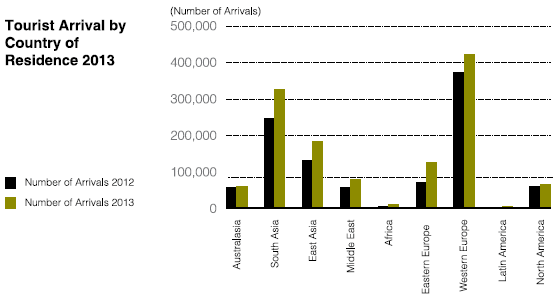
The tourism boom continued in 2013 with the number of visitors growing by 27% to reach 1.27 million tourists.
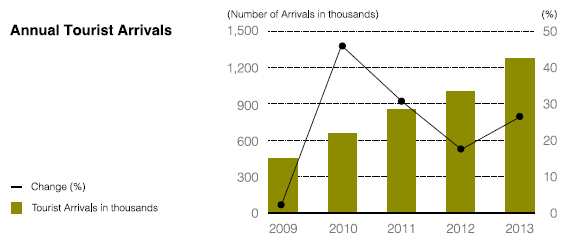 |
Although Western Europe continued to be the prime source market for tourists to Sri Lanka, tourist arrivals from emerging market economies increased significantly in 2013. Consequently, tourist arrivals from Western Europe as a share of total arrivals fell to 33% in 2013 from 37.1% in 2012, although the number of tourist arrivals from this region increased by 12.9%, year-on-year in 2013.
On the other hand, the share of tourist arrivals from East Asia, South Asia, Eastern Europe and Middle East increased due to effective and strategic promotional campaigns executed during the year focusing on emerging markets. The South Asian region which was the second major market accounted for 25.6% of arrivals in 2013 compared to 24.6% in 2012.
 |
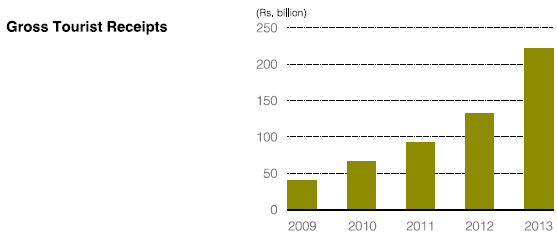
Earnings from tourism continued to grow considerably in 2013. The continuous increase in tourist arrivals and an increase in average spending per tourist resulted in earnings from tourism recording US$ 1,715 million in 2013, compared to US$ 1,039 million in 2012. This shows a significant growth of 65%.
 |
According to the Sri Lanka Tourism Development Authority (SLTDA), the average spend per tourist per day increased to US$ 156.5 in 2013 from US$ 103 in 2012, while the average duration of stay per tourist decreased to 8.6 days in 2013 from 10 days in 2012.
We note that the SLTDA and other relevant authorities have stepped up efforts to reach the target of 2.5 million tourists by 2016. This is evident from several promotional campaigns carried out during 2013. Sri Lanka’s first ever mega joint promotional campaign, with the involvement of public and private sectors named ‘Get SriLankan’ed’, was launched in India followed by a high profile media conference as well as Business to Business meetings across the areas of travel and trade. The main aim of this campaign was to position Sri Lanka as the most preferred travel destination in emerging markets. In addition, promotional campaigns were held in Russia and other CIS countries as well as in emerging high potential markets such as China.
(Sources: World Tourism Organization, IMF Report, the Central Bank of Sri Lanka Annual Report 2013 and the Sri Lanka Tourism Development Authority.)