Maldivian Operations
• Project financing for resort
development • Lender in syndicated borrowing
e- Exchange
• Combank e-Exchange - Web-based
money transfer facility
Core Competencies Bangladesh Operations
• Strong presence in Corporate Banking
established since the time of CAI • Zero non-performing advances • Linked branch network • High level of professtionalism • State-of-the-Art information
technology
Maldivian Operations
• Well established long-standing
relationship with the Maldivian
customers
e- Exchange
• Strong Agent network spread across
the globe • Placement of Business Promotions
Officers in main corridors for
ground level marketing • State-of-the-art information
technology •‘ComNet’ computer linked branch
and ATM network
Future Strategies Bangladesh Operations
• To maintain the image as a highly
reliable and steady bank • To consolidate the operations • To engage in Islamic Banking • To popularise Bank’s IT based services • To expand more delivery channels
Maldivian Operations
• Consolidate our operations in
Maldives
e- Exchange • To develop low cost e-based delivery
channels • To expand agent network for
e-Remittances • Set up our own Exchange Companies
in highly potential markets
Overview
Low GDP growth rate, deficit in Balance of Payment and high rate of inflation over a considerable period of time are some of the key macro economic indicators of a developing economy. These general trends which are prevalent in a developing country are clearly seen within the Sri Lankan economy as well. The situation is further aggravated by the country being dragged into a long running civil conflict.
In its strategic planning process, the Bank correctly identified the ramifications of depending on a single economy. Having recognised the dangers of depending on the Sri Lankan economy alone, the Bank took several initiatives to mitigate the risk posed by the internal environment, most of which have been duly incorporated into the vision of the Bank.
With the acquisition of Credit Agricole Indosuez in Bangladesh in 2003, the Bank took its first major initiative of stepping beyond the shores of Sri Lanka and even up to now Commercial Bank is the only Sri Lankan bank which operates a network of branches in a foreign country. With these initiatives, a reasonable amount of Bank’s assets are spread over other economies and this amount has been gradually increasing over the period.
A fair amount of the Bank’s Off Shore Banking Centre assets had been invested in the high-end tourism industry in Maldives and this amount had grown consistently over the period
of time.
Now, the Bank is a dominant player in the money remittance business. Our global presence is visible through a net work of direct and indirect agents with whom we have tied up for handling inward remittances of the large Sri Lankan expatriate community. We have extended the same services to Bangladesh operations as well.
Achievements - 2007
Bangladesh Operations • Bank’s Bangladesh operations, which commenced with a Total Deposits of BDT 3.9 billion in December 2003, reached a total Deposit base of around BDT 10.0 billion mark at the end of the year 2007. Advances portfolio of the Bank, which was BDT 2.9 billion as at December 31, 2003, has reached BDT 8.0 billion as at end of December 2007
• Deposits and Gross Advances grew by 22.0% and 16.77% respectively, further consolidating our position in Bangladesh.
• The number of accounts has increased more than 4 times compared to the end of December 2003.
• Opened an Off-Shore Banking Unit Office in the Chittagong Export Promotion Zone (CEPZ).
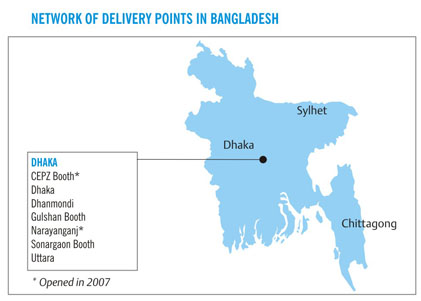
• Opened the sixth Branch and the ninth service outlet at Narayangonj, bringing the total number of branches and booths in Bangladesh to nine and increased the number of ATMs to 10 including 2 at off-site locations, reflecting our continued commitment to the country and exhibiting the desire to gradually move into Retail Banking.
• The number of Debit cards issued during the year exceeded 1,300 and the total number Debit cards issued exceeded 4,500 as at December 31, 2007.
• An agreement was signed with Dutch Bangla Bank Ltd. which has an ATM network of over 200, to enable our customers to use their ATMs.
• An agreement was signed with Islami Bank of Bangladesh, in addition to the existing agreement with Prime Bank Ltd., to disburse funds received from Bangladeshi Wage Earners abroad.
•‘Probriddhi Loan’ an SME based loan scheme and lease financing was commenced.
•Custodial Services was launched to provide assistance to capital market foreign investors.
• Received an award at the Financial Mirror Robintex Business Award 2007 as the Best Foreign Bank.
• Was placed third under “Foreing Bank Category” in the Best Corporate Award 2007 by the ICMAB.
Lending to Maldivian Operations • Lending portfolio to the Maldivian corporate clients expanded satisfactorily under the purview of the Corporate Banking division. The exposure to the high-end tourism industry in Maldives is of high quality though the Bank is not physically present in that country.
Money Remittance Business • Recorded commendable growths in number of remittances and volumes. Number of remittances grew by over 60.0% while volumes recorded a phenomenal increase of over 90.0%. The money Remittance Business comes under the purview of the Personal Banking division.
• Aggressive expansion of the Agent network.
• Placement of new Business Promotion Officers in Middle Eastern countries and Italy.